
In my previous post, we introduced a different perspective on nutrition. The aim here is to present a simpler and more accessible view of nutrition…and, if reading about nutrition–even a kinder, gentler sort of nutrition–is likely to be triggering for you, please feel free to skip this one. (Here’s a video of Hector basking in the sun). Take good care of you.
This post continues our conversation about nutrition by discussing one of the more important starting points, that beloved (and oft misunderstood) macronutrient, protein! (Woohoo!!!)
Protein is kind of a big deal and we’ve found that it often gets a bit under-appreciated. So we’re going to start with some love for protein (and some science!):
First, let’s make sure we’re all on the same page
Protein is one of the three main macronutrients that makes up the food we eat. (Carbohydrates and Fat being the other two).
In terms of chemistry, protein molecules are made up of connected chains of smaller molecules called amino acids.
Amino acids are the building blocks for lots of stuff in our bodies:
- All of your body’s enzymes,
- All of your cell transporters, cell scaffolding and structures,
- Your hair and fingernails,
- All of the transporter molecules in your blood,
- Much of your muscles, bones and internal organs,
- Many hormones are mostly protein…
The interesting—and important—thing is that we don’t store extra amino acids. And while our bodies are constantly using and recycling protein, we have to be regularly replenishing our body’s supply of protein.
How much protein should I eat?
This is where our conversation needs to take a brief detour.
When we talk about meals and serving sizes, we are not in the practice of advising you to get out your measuring cups and kitchen scale. And while we are talking explicitly about protein, generally we steer clear of “counting your macros”.
I just packed a whole lot into those two sentences. Let’s unpack each one briefly:
Serving Sizes
For the purposes of our conversations on nutrition and meal-making, we are going to use serving size recommendations based on your hand. For example, (spoiler alert) later on in this email I’m going to suggest starting with 1-2 palm-sized servings of protein per meal.
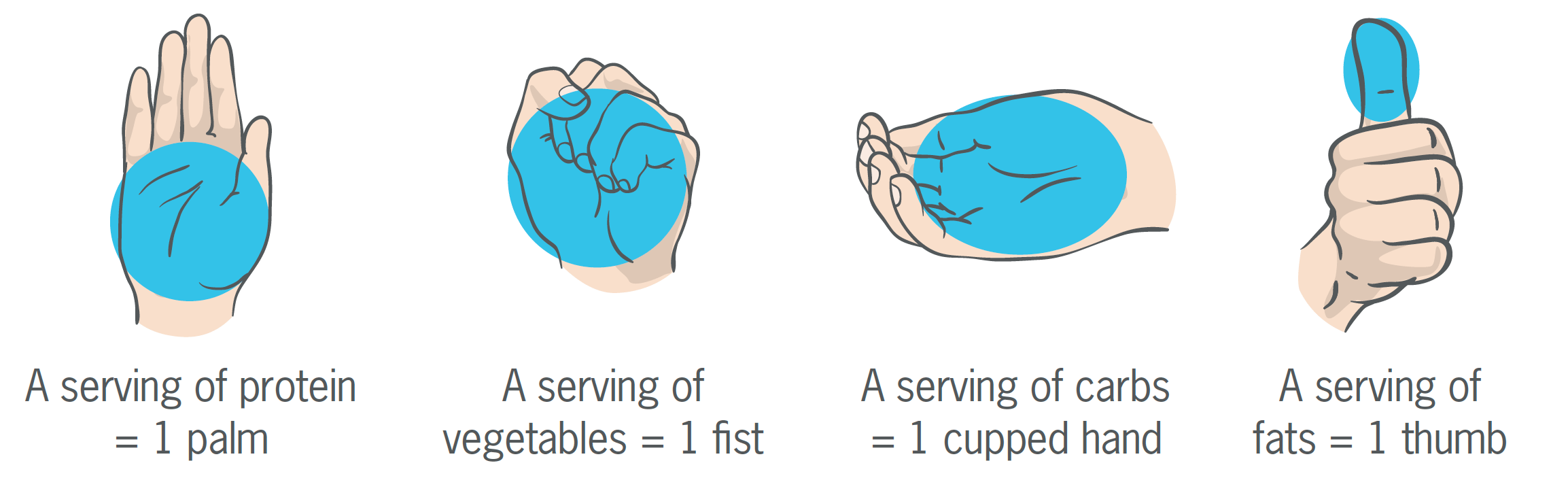
Your hands are portable—they’re pretty much always with you—and are a consistent size, which makes for a consistent reference. They scale with each individual and they make for a quick and easy way to track nutrients, food choices and energy.
Though serving sizes based on hand-size are an approximation, it’s actually more than sufficiently accurate.
And besides, measuring calories is actually a rather problematic and flawed idea. (Get a quick overview of why here and here. Go for a deeper dive here and here).
Having said all of that, if you derive a great deal of joy from the practice of counting macros (macronutrients) and measuring precise amounts of food for each meal, we are not going to yuck your yum and will instead support you 100% in that regard.
Recommended Daily Allowance for Protein
There exists, out there in the world, the Recommended Daily Allowance (RDA) for protein. Currently, if you’re curious, it’s 0.8 g/kg (0.36 g/lb).
The thing with RDAs is that they were originally developed as a way to avoid malnutrition. That means they represent the bare minimum of a particular macronutrient required for you not to die.
For our purposes, there’s a worthwhile distinction to be made between ‘not dead’ and ‘kicking ass’.
So…eating more than the bare minimum amount of protein is one of those factors that contributes to becoming more and more badass.
For example, and at the risk of pointing out the obvious, eating more protein is particularly beneficial when you’re physically active because of the role it plays in building and maintaining muscle mass.
Higher protein diets can also:
- lower blood pressure,
- improve glucose regulation,
- improve blood cholesterol; and
- improve other indicators of cardiometabolic health.
My Restaurant Kitchen Analogy
Dietary protein gets broken down into amino acids. Those amino acids end up circulating in your bloodstream and are referred to as the body’s amino acid pool.
Imagine a kitchen in a busy restaurant.
The ingredients in the kitchen are like the pool of amino acids: ready to be used when there’s a demand for new proteins to be made in the body.
As the servers in the front of house plug food and drink orders into the computer, a small little printer in the kitchen spits out the food orders on little chits of paper.
[For those who have never worked in the service industry or might not be in the know, those little pieces of paper that the printer spits out are called chits. I don’t know why. They just are.]
The chef takes each of these chits and lines them up and makes decisions about which orders to fulfill in which order as they come in.
In the body, there are all sorts of basic maintenance operations that get first dibs on the amino acid pool:
- Help to replace worn out cells,
- Contribute to regular growth and repair of all the things, such as hair and fingernails
- Transport important nutrients around the body,
- Ensure good immune system function…
You get the idea.
Now, when a person is eating a relatively small amount of protein, “the chef” will always prioritize the basics. Things like using amino acids to grow new muscle as a result of your strength training endeavors take a back seat.
Sure, amino acids will be used to recover from your training…but in the absence of more amino acids, that tends to be it.
On the other hand, once the body has fulfilled all of the ‘basic bodily maintenance and function’ chits, and there are still amino acids remaining in the pool, then the body can not only use them for building stronger muscles, this extra protein can trigger elevated levels of hormones such as glucagon which can help to liberate stored fuel for your muscles…essentially giving you more energy to do cool stuff.
So, how much protein should I eat?
You may have noticed that I’ve made repeated references to higher protein diets. That’s something we should clarify:
For the most part, when we say higher protein, we’re talking about dietary protein content that is higher than the RDA for protein (because, again, the RDAs were created with only the bare minimum amount of energy required to simply survive…RDAs do not take into account things like the energy required to move around and do things).
And we might also be talking about a diet that includes more protein than you’re used to consuming. (Or not—your mileage may vary).
So, when considering the question of how much protein should I eat? typically, we would ultimately aim for two palm-sized servings of protein in each meal.
Now, I would like to be clear: we usually don’t just launch into two palms of protein at every single meal. We usually frame this nutrition adventure in terms of conducting ongoing experiments. For example, it might be the smartest and most accessible move to start with one particular meal out of your day (where you might not be getting enough protein) and working to improve that one. We would try that for a week or two, troubleshooting along the way, and then build from there. (By ‘build from there’, I mean, once you feel confident in your ability to consistently get enough protein into one meal, we can move on to a different meal in your day or week and see how that goes).
Along the way, we would ask you to observe things like your energy levels, feelings of satiety, etc. as a way to gauge whether it may serve to increase or decrease your daily protein serving sizes. For reference, the more active you are, the more you’re likely to benefit from more protein in your diet.
So, if you’re curious, I invite you to have a look at how much protein you’re consuming in a typical day and then use the strategies here to create an experiment for yourself. Alternatively, feel free to reach out and we’ll see if we can troubleshoot together.


